Ask a question
You can ask questions or search for stories, guides, or tools that help you.

You can ask questions or search for stories, guides, or tools that help you.

The website remembers your choices on this device only. If you use another phone or computer, your settings will not be there.
When we received the call from support staff early on a Tuesday morning, we knew the day would require coordination, clarity, and collaboration.
A participant we support through the NDIS stands for National Disability Insurance Scheme. It is an Australian government program that provides funding and support to people with a permanent and significant disability so they can live more independently and achieve their goals. was being transferred to hospital following a sudden deterioration in their health. While the hospital staff were responsive and professional, as is often the case they were unfamiliar with the participant’s communication needs, daily routines, and the supports that help them remain safe and regulated.
From a service provider perspective, moments like this clearly demonstrate how the NDIS and NSW Health systems intersect—but do not duplicate one another.
Our first step was to engage appropriate support staff to attend and assist the participant in the emergency department, while also determining clinical status and liaising with family members and appointed decision makers to ensure they were informed and supported.
While NSW Health assumed responsibility for all medical treatment and clinical care, our role focused on non-clinical supports, ensuring the participant’s needs as a person—not just as a patient—were understood and communicated.
We provided the ward with key information, including:
The participant’s communication preferences
Information about behaviours of concern and known triggers
Details of legal decision makers and emergency contacts
Daily living needs that may impact care, such as mobility requirements, personal care preferences, and sensory sensitivities
This information often fills a critical gap. Hospital environments are fast paced and risk focused, whereas NDIS supports are built around routine, familiarity, and long term Wellbeing is how you feel in your body and mind. It includes your health, your feelings, and how you manage everyday life..
Throughout the admission, consistent communication was maintained to ensure roles and boundaries were clear and respected:
NSW Health managed all clinical Decisions are choices you make after thinking about different options., medication administration, nursing care, and discharge planning from a medical perspective.
Our service supported the participant emotionally, assisted with communication, and helped them cope with the unfamiliar hospital environment—where this was appropriate and agreed.
We were mindful not to overstep into areas that sit solely within Health’s responsibility. At the same time, we advocated strongly to ensure clinical decisions were informed by a full understanding of the participant’s disability related needs.
Hospital admissions can be extremely distressing for people with disability. Noise, lighting, frequent staff changes, and disruptions to established routines can quickly escalate anxiety or behaviours of concern.
Where permitted, our staff supported the participant to:
Understand what was happening and what to expect
Communicate pain, discomfort, or fear
Feel reassured through familiar faces, communication styles, and support approaches
These supports reduced distress, lowered the risk of escalation, and helped hospital staff to deliver care more effectively.
Discharge planning is where the NDIS–Health interface becomes most visible—and often most challenging—if not managed well.
From early in the admission, we engaged with hospital staff regarding:
Expected discharge timeframes
Any changes to the participant’s capacity or support needs
Equipment requirements, medication changes, and follow up appointments
While NSW Health determines when a person is medically ready for discharge, NDIS supports must be in place for discharge to be safe and sustainable. Where care needs change, supports cannot be assumed to adjust instantly.
We worked closely with Support Coordinators and the participant’s family to ensure:
Support hours aligned with post hospital needs
Support staff were briefed on changes to care requirements
Family members and guardians understood the next steps
A rushed discharge without adequate planning or supports in place increases the risk of readmission—a risk for everyone involved.
Hospital admissions highlight both the strengths and gaps that can exist between service systems.
When collaboration works well:
Participants feel safer and better understood
Hospital staff are supported to focus on clinical care
Transitions are smoother and outcomes improve
When roles are unclear or communication is rushed, participants can easily fall between systems.
From our perspective as a service provider, our role is not to replace NSW Health, but to bridge understanding, Advocacy is having your voice heard so your rights and needs are met. An advocate is a person who speaks up to get you the support you need. appropriately, and maintain the participant’s voice during a vulnerable time.
Every hospital admission reinforces the importance of respectful collaboration, clear
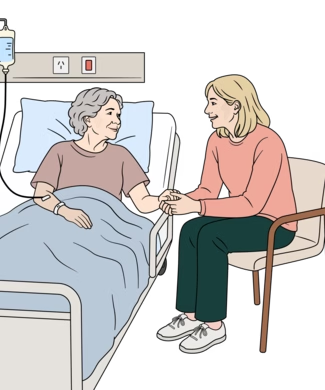

Tory and Courtney work at Gresytanes Disability Services and are members of the Our Health Space Community.
Help others learn and feel connected by telling your story here. You can write or record it. You can get help telling your story if you need it.