Ask a question
You can ask questions or search for stories, guides, or tools that help you.

You can ask questions or search for stories, guides, or tools that help you.
The website remembers your choices on this device only. If you use another phone or computer, your settings will not be there.
In my work supporting people with disability, including people with Complex means something can be harder to understand because there is a lot to think about. health needs, I have learned some important things about health and quality of life.
One key thing is that health should be part of a person’s life, not the only focus. Many people we support have disability‑related health needs that are part of their everyday life. These supports may be needed 24 hours a day.
When someone needs support all the time, this requires trust, and consistent relationships, and strong knowledge of the person. Staff need to understand what matters most to that person and what helps them feel safe, respected, to have a good quality of life.
Good support is person centred ensuring the person is actively involved in all areas of their life and not treated like a by stander this means supporting people in ways that work for them.
Person‑centred support includes:
All these things help build trust and improve health outcomes and are important when supporting people access health services.
Daily supports are an important part of health including
These supports require partnership between the person and their support team and is particularly important when people rely on people to meet these daily needs.
For people without disability, our daily care is often taken for granted when you can hold a cup or spoon yourself, shower independently we may not think about the essential role hygiene eating and toileting has on our health.
But for people with disability, who require support to meet these needs supporting a person correctly is critical.
In terms of health Rights and If something is accessible, it means that everyone can use and understand something. For example: Accessibility makes things fair for people with a disability. If something is accessible, it means that everyone can use and understand something. For example: Accessibility makes things fair for people with a disability. everyone has the right to good health care when we make the world universally it makes communities better for everyone.
Planning for Emergencies-health emergencies can happen at any time planning ahead is very important.
Individual care plans, current medication list, emergency contact and a one‑page profile “About Me”.
These documents should be easy to find and easy to read. They help hospital staff and emergency workers give the right support quickly.
Hi, my name is Tom with photo
I have a disability called cerebral palsy and am non‑verbal please explain things to me simply.
It’s important to me I know what is happening and that people talk with me before doing something.
I have a rod in my spine, when I am moved, I need to be rolled carefully
Loud sudden sounds frighten me
I communicate using my eyes and facial expressions
My mum’s name Jen please contact her in an emergency
Other important things to know I have Epilepsy is a condition that affects the brain and can cause a person to have seizures. A seizure happens when there is a sudden burst of electrical activity in the brain. Seizures can affect a person's movement, awareness, feelings, or behaviour., allergy to nuts
Medical settlings can have lots of unfamiliar sounds and smells and lots of talking that can be confusing. Helpful support to include is familiar support people being present, Comfort items such as a blanket, familiar smells or objects, simple clear explanations before any procedures.
The information on Our Health Space has lots of great resources and links to help support people with health support. Asking A doctor that you see when you need a health check for help in how best to support person ahead of health appointments is valuable too.
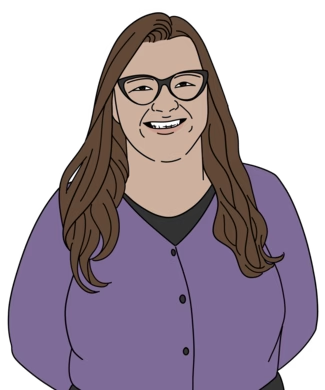
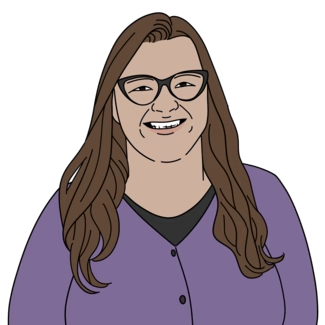
Amanda is the CEO of Greystanes Disability Services and a member of the Our Health Space community from NSW.
Help others learn and feel connected by telling your story here. You can write or record it. You can get help telling your story if you need it.